

Kanaalkruising Sluiskil
 

Speed

Speed

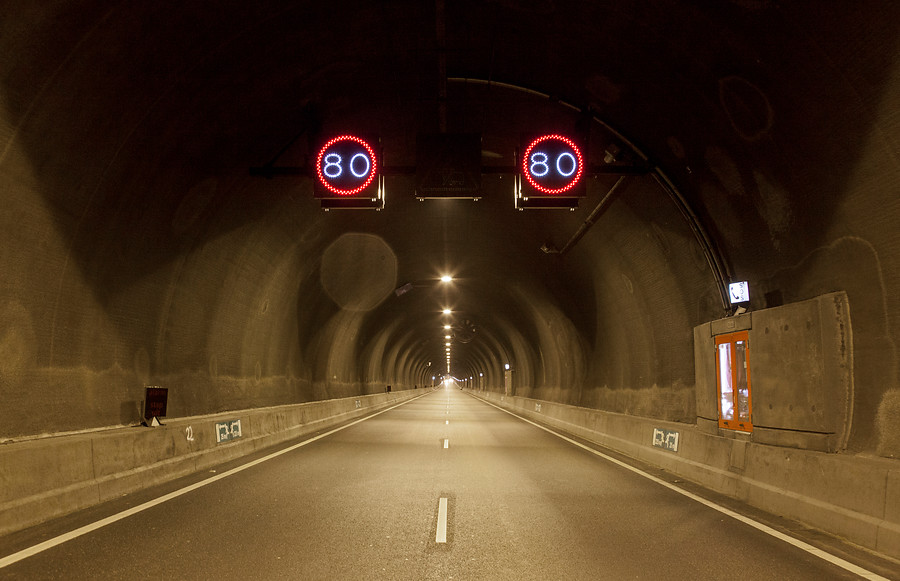
A maximum speed limit of 100km per hour is in force in the Westerschelde Tunnel, unless otherwise indicated on the Matrix Signal Indicators in the tunnel. On the N62, from the roundabout (N61/N62) in the direction of the tunnel, the first section of the road is subject to an 80km per hour speed limit. Not until the sign 'autoweg' (motorway) has been passed is it permitted to drive at 100km per hour.

In exceptional circumstances, during emergency repairs, accidents, etc., it may be necessary to impose speed restrictions for safety reasons. These restrictions are indicated on the Matrix Signal Indicators in the tunnel. In the case of calamity or other unforeseen circumstances it may be necessary to close off the tunnel bore which is affected. Naturally this will only take place when the safety of the tunnel users can no longer be guaranteed.

Gradient

On both its south side (Zeeuws-Vlaanderen) and its north side (Zuid-Beveland), the Westerschelde Tunnel has a gradient of 4.5% over a distance of 1200 metres. This makes it a very long and steep gradient by Dutch standards. Many motorists are taken by surprise at encountering such gradients in the otherwise flat countryside of the Netherlands. This means that you will need to adjust your speed well in advance, especially if you are towing a trailer. If you only start to break once you are already on the slope, you may lose control of the steering, and in the worst case your vehicle may jack-knife. If you begin to decrease your speed in plenty of time, you will be able to enjoy a relaxed journey through the Westerschelde Tunnel.

section speed control

Section Speed Control
In the Westerschelde Tunnel the speed of road users is constantly monitored by speed-over-distance cameras. Motorists are not permitted to exceed the speed limit of 100km per hour. However, this speed limit is regularly broken, sometimes by a very high margin. Such behaviour can result in life-threatening situations, especially inside a tunnel. By using section speed control (speed-over-distance cameras) the Bureau for Traffic Enforcement of the Public Prosecution Service (BVOM) and the tunnel manager of N.V. Westerscheldetunnel, hope to improve traffic safety. Section speed control always results in a marked decrease in the number of speeding offences.

How does section speed control work?
Where section speed control is in force, cameras are installed at various points along the route, recording every passing vehicle. The resulting images are fed into a computer which calculates the average speed of the vehicle. If this is higher than the maximum speed limit, then the road user will be sent a fine. Where the system is in force, speeding motorists have a 100% chance of being caught. Section speed control is not meant to replace static speed cameras, but is a supplement to the existing control methods (static speed cameras, mobile radar apparatus, video surveillance etc.).

Important note: the maximum speed limit may be 100km per hour, but certain vehicles are required by law to adhere to a speed limit of 80km per hour. These vehicles are recognisable by their different registration number. Is your vehicle subject to a speed restriction of 80km per hour, and yet you drive through the tunnel at a speed of 90km per hour? You can expect to receive a speeding ticket in the post.